residual-moisture-testing-for-lyophilized-drugs

What if the greatest threat to your lyophilized drug's stability is measured in micrograms of water? For CMC leaders, uncontrolled residual moisture can lead to costly delays and compromised programs. Dive deeper to protect your biologic.
Menu
Is Residual Moisture Silently Sabotaging Your Lyophilized Biologic? A Guide for CMC Leaders
The High-Stakes Reality of Moisture Control
Quick Facts: The Impact of Residual Moisture
From Reactive Testing to Proactive Design: A More Controlled Approach
Secure Your IND Submission and Move Forward with Confidence
Is Residual Moisture Silently Sabotaging Your Lyophilized Biologic? A Guide for CMC Leaders
What if the greatest threat to your lyophilized drug's stability is measured in micrograms of water? For Chemistry, Manufacturing, and Controls (CMC) and Drug Product leaders, the pressure to deliver a stable, scalable formulation against tight IND submission windows is always there. A failed stability test can mean a costly, multi-month delay. Good biologics often face setbacks at this stage due to issues like aggregation or loss of potency, where the root cause is frequently traced back to improperly controlled residual moisture.[1, 2, 3]
You have successfully optimized the molecule and scaled the drug substance process. Now, the stability of the final drug product rests on the delicate balance of water content left after lyophilization. Get it wrong, and you risk compromising the entire program.
The High-Stakes Reality of Moisture Control
Residual moisture is a key quality attribute (CQA) for lyophilized products, directly influencing their physical and chemical stability. It acts as a plasticizer, lowering the glass transition temperature (Tg) of the formulation. When storage temperature exceeds the Tg, molecular mobility increases, accelerating degradation pathways like aggregation and deamidation.[13, 14, 7]
For most lyophilized biologics, the target residual moisture level is between 1% and 3%. This is not a universal rule.
Too much moisture: Can accelerate hydrolysis and lead to aggregation, compromising product safety and efficacy.[12, 4, 9]
Too little moisture (over-drying): Can also be bad, potentially denaturing the protein by removing the essential water molecules required for structural integrity, leading to aggregation and loss of activity.[12, 4, 9]
Finding the optimal moisture level through iterative freeze-drying cycles and long-term stability studies is a time-consuming process you cannot afford. Each cycle adjustment adds weeks to your timeline, eating into your IND submission window and burning through valuable API.
Quick Facts: The Impact of Residual Moisture
Stability Risk: Storing a lyophilized product above its glass transition temperature (Tg), which is lowered by excess moisture, can lead to cake collapse and accelerated protein aggregation.[13, 14, 7]
Regulatory Scrutiny: The FDA requires that each lot of a dried biological product be tested for residual moisture to ensure it meets established limits supported by stability data.[10, 11, 15]
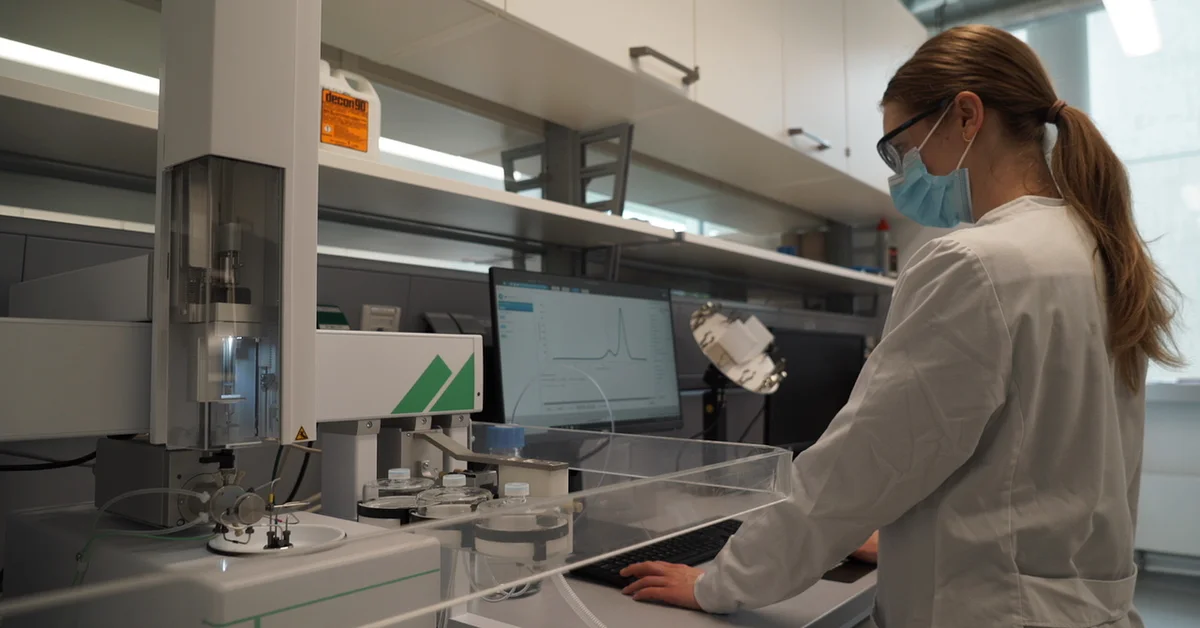
Analytical Challenges: Standard methods like Karl Fischer (KF) titration are destructive, require careful handling to avoid atmospheric moisture contamination, and can be time-consuming, limiting their utility for large batches.[16, 4, 5]
Beyond the Cake: Moisture can also be introduced from the elastomeric stopper during storage, making stopper selection and preparation a critical, often overlooked, factor.[17, 5]
From Reactive Testing to Proactive Design: A More Controlled Approach
The usual way to manage residual moisture involves developing a lyophilization cycle, testing what comes out, and adjusting parameters based on stability results. This is a reactive and inefficient cycle. A modern, Quality by Design (QbD) methodology, as encouraged by ICH Q8 guidelines, needs a more proactive and predictive plan.
Here is a concrete action plan to gain control over residual moisture and de-risk your CMC timeline:[18, 19, 20]
1. Predict Developability with an AI-Guided Platform
Instead of discovering the optimal residual moisture target through months of physical stability studies, you can predict it from the start. Our AI-driven platforms model the interactions between your molecule and various excipients to identify a formulation with the highest possible glass transition temperature. This predictive step identifies the ideal formulation and its optimal residual moisture target before the first lyophilization cycle begins, saving critical time and material.
2. Engineer a Robust, Optimized Lyophilization Cycle
The insights from the formulation design directly guide the creation of an efficient and robust lyophilization process. By knowing the precise thermal properties of the optimized formulation, we can design a cycle that consistently achieves the target residual moisture level. This reduces batch-to-batch variability and simplifies the tech transfer and scale-up process. A 1°C increase in product temperature during primary drying can reduce the cycle time by as much as 13%, but this can only be done safely with a high-Tg formulation.
3. Deliver an IND-Ready, Data-Driven CMC Package
The output is not just a stable product; it is a comprehensive, IND-ready data package.[23] This includes a robust formulation, a validated and efficient lyophilization process, and a clear scientific justification for your residual moisture specification. This level of process understanding provides confidence for regulatory submissions and cuts down on questions from health authorities. After switching to a predictive formulation platform, one of our partners stabilized their lead AAV candidate at ambient temperature, eliminating cold-chain dependency and accelerating their path to the clinic.
Secure Your IND Submission and Move Forward with Confidence
Controlling residual moisture is more than just a QC test; it is a key part of ensuring your product's long-term stability, clinical success, and its market success. Stop relying on trial-and-error cycles that introduce risk and delays into your development program.
Schedule a strategy call with our formulation experts. We can help you accelerate your CMC timeline, reduce stability risks, and advance your program with a smart, data-backed approach.
[Accelerate Your CMC]
IND-ready · De-risked · Scale-tested · Room-temp optimized · No guesswork